
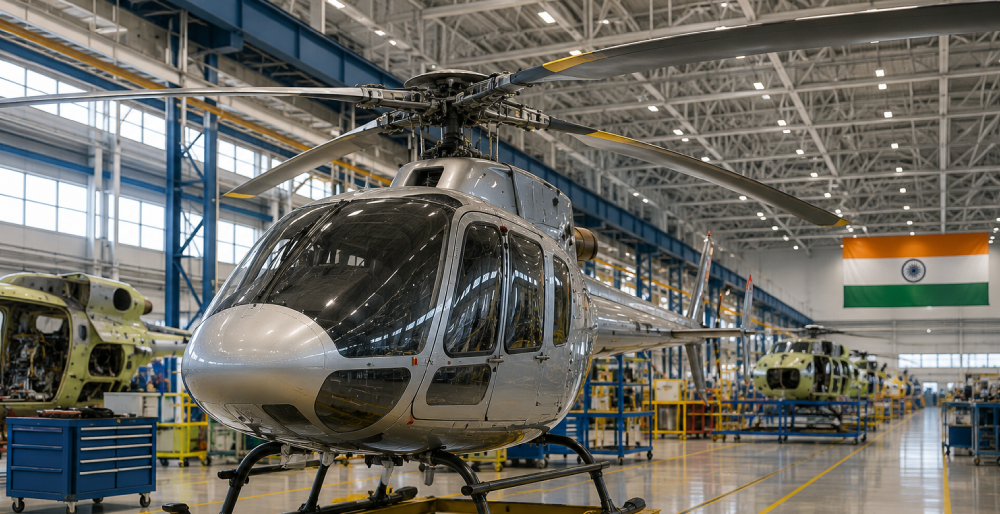

For decades, India’s aviation industry has been defined by one reality: aircraft were largely designed, manufactured, and assembled overseas before entering the Indian market.
That narrative is beginning to change.
With the establishment of the country’s first private helicopter final assembly lines and new collaborations between global aerospace companies and Indian industry leaders, India is steadily positioning itself as an emerging manufacturing destination for the global aerospace sector.
The significance of these developments extends far beyond manufacturing. They have the potential to influence aircraft availability, leasing, maintenance capabilities, employment, and the overall competitiveness of India’s aviation ecosystem.
A New Chapter for Indian Aerospace
India’s first private helicopter final assembly line, developed through the Airbus and Tata Advanced Systems partnership in Karnataka for the H125 and H125M helicopters, marks an important milestone for the country’s aerospace industry.
At the same time, partnerships such as the Adani-Leonardo collaboration demonstrate increasing confidence in India’s manufacturing capabilities and long-term aviation potential.
These projects indicate a clear shift in India’s role within the global aerospace value chain.
Instead of being primarily an importer of aircraft, India is gradually becoming a participant in their production.
Incidentally, Skypulse’s current fleet includes both Leonardo and Airbus machines that have acquitted themselves very well in Indian flying conditions and market. Not just that, they also feature in Skypulse’s further fleet expansion plans.
Why Domestic Manufacturing Matters
Aircraft manufacturing creates value far beyond the assembly facility itself.
A strong manufacturing ecosystem encourages growth across:
- Component manufacturing
- Precision engineering
- Maintenance, Repair and Overhaul (MRO)
- Logistics and supply chain services
- Aviation training
- Research and development
- Skilled employment
Each new assembly line strengthens India’s aerospace capabilities while creating opportunities for local suppliers and technology partners.
This helps build an integrated aviation ecosystem rather than relying entirely on overseas production.
Strengthening India’s Aviation Supply Chain
One of the biggest lessons from recent global supply chain disruptions has been the importance of domestic manufacturing capacity.
The aviation industry depends on highly coordinated supply networks. Delays in production or logistics can affect aircraft deliveries, maintenance schedules, and fleet expansion plans.
Expanding local manufacturing helps reduce these risks by:
- Improving supply chain resilience
- Supporting faster delivery timelines
- Increasing local technical expertise
- Reducing dependence on imported components where feasible
- Reducing components and maintenance costs
- Delivering greater business viability
For operators and leasing companies, a stronger domestic ecosystem can contribute to greater operational certainty over the long term.
Opportunities for Aircraft Leasing
The growth of aircraft manufacturing also complements India’s ambitions to become a global aircraft leasing hub through GIFT IFSC.
Manufacturing, financing, leasing, maintenance, and asset management are interconnected parts of the same aviation ecosystem.
As India develops capabilities across these segments, opportunities emerge for:
- Fleet financing
- Aircraft leasing
- Asset management
- Technical support services
- Aviation investment
This integrated approach has been a key driver behind the success of established aviation hubs such as Dublin and Singapore.
India is now beginning to build similar foundations.
Supporting National Aviation Growth
India is expected to remain one of the world’s fastest-growing aviation markets over the next decade.
Airlines have collectively placed orders for thousands of new aircraft, regional connectivity continues to expand, and demand for helicopters is increasing across multiple sectors.
These include:
- Corporate aviation
- Emergency medical services
- Tourism
- Offshore energy
- Law enforcement
- Disaster response
- Infrastructure development
Developing domestic helicopter manufacturing capacity positions India to support this growing demand while reducing long-term dependence on imported platforms.
More Than Manufacturing
The true significance of these projects lies not only in assembling helicopters but in building industrial capability.
Successful aerospace manufacturing requires:
- Advanced engineering
- Highly skilled talent
- Robust quality systems
- Global certification standards
- Long-term technology partnerships
Every step in this direction strengthens India’s position within the global aerospace industry.
It also creates an environment that encourages innovation, investment, and collaboration across the aviation value chain.
Looking Ahead
India’s aviation story is no longer limited to passenger growth or airline expansion.
The industry is evolving into a complete ecosystem that includes manufacturing, financing, leasing, maintenance, and advanced aviation services.
The emergence of private helicopter assembly facilities demonstrates that India is steadily moving up the aerospace value chain.
While this transformation will take time, it represents an important shift in the country’s aviation journey.
For industry stakeholders, the message is clear. India’s future in aviation will not be defined only by the number of aircraft flying in its skies, but also by the growing capability to build, finance, lease, and support those aircraft from within the country itself.