
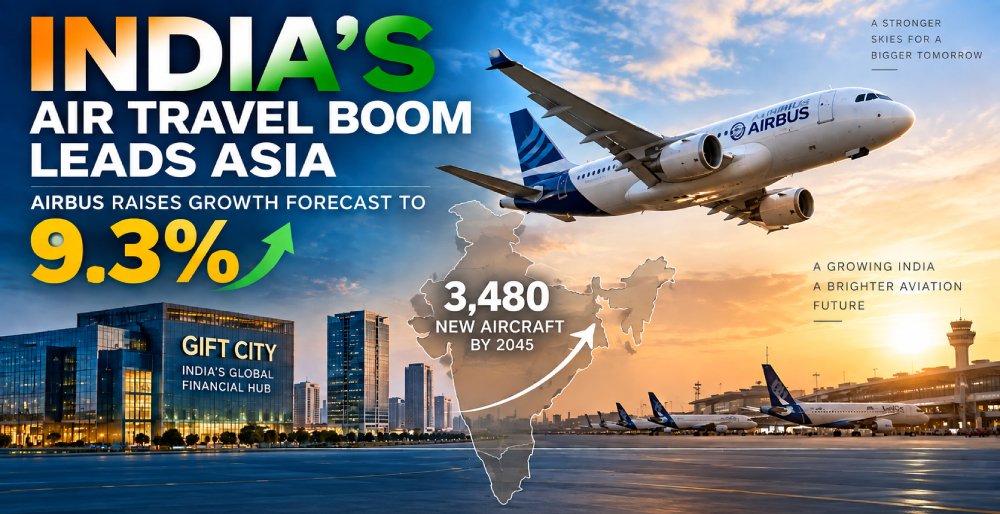

India’s aviation sector is entering a period of sustained long-term expansion, with Airbus raising its forecast for domestic air traffic growth to 9.3% annually through 2045, up from its previous estimate of 8.9%.
The revised outlook, part of Airbus’ 2026–2045 Global Market Forecast, places India among the fastest-growing aviation markets in the Asia-Pacific region. Airbus expects Indian airlines to require approximately 3,480 new passenger aircraft over the next 20 years, highlighting the scale of fleet expansion that could lie ahead.
The forecast comes despite geopolitical uncertainty, supply-chain constraints and other pressures affecting the global aviation industry. According to Reuters, Airbus continues to see strong demand from airlines and no significant softening in aircraft delivery requirements.
India’s Domestic Air Travel Growth Reaches 9.3%
Airbus has increased its projection for India’s domestic air traffic growth from 8.9% to 9.3%.
This puts India ahead of China in the latest Airbus forecast. China’s domestic traffic growth projection has been reduced from 5.4% to 4.7%.
The difference highlights the changing dynamics of the Asia-Pacific aviation market, where India is emerging as a major source of incremental passenger demand.
Airbus’ broader 2026–2045 forecast estimates global passenger traffic will grow by around 3.9% annually, with global air traffic expected to more than double to approximately 10 billion passengers per year by 2045.
India Could Require 3,480 New Passenger Aircraft
The most significant implication of the forecast is the expected scale of India’s future fleet requirement.
Airbus estimates that India will require approximately 3,480 new passenger aircraft over the next two decades. This requirement reflects both passenger traffic growth and the replacement of older aircraft.
Globally, Airbus forecasts demand for approximately 42,060 new aircraft between 2026 and 2045. Of these, around 33,920 are expected to be typically single-aisle aircraft, while approximately 8,140 will be widebody aircraft.
For India, this creates opportunities across the wider aviation ecosystem — including airlines, airports, MRO providers, aircraft financing companies, lessors and aviation services companies.
Why India’s Aviation Market Is Expanding
Several structural factors are supporting India’s long-term aviation growth.
1. Rising passenger demand
As India’s economy and disposable incomes expand, air travel is becoming increasingly accessible to a larger section of the population.
Airbus expects India’s aviation growth to be supported by economic development, urbanisation and increasing connectivity.
2. Expansion beyond major metropolitan hubs
One of the important themes in Airbus’ latest forecast is the decentralisation of aviation networks.
The company expects smaller and medium-sized cities to grow faster than some larger urban centres, creating opportunities for airlines to establish new direct city-pair connections rather than relying exclusively on traditional major hubs.
For India, this could mean continued expansion of regional connectivity and increased demand for aircraft capable of operating efficiently on a wider range of routes.
3. Fleet replacement
Growth is not the only driver of aircraft demand.
Airlines will also need to replace older aircraft with newer, more fuel-efficient and operationally efficient models. Airbus estimates that globally, 19,820 of the 42,060 aircraft required through 2045 will replace existing aircraft.
This creates a dual demand cycle: airlines need additional capacity while simultaneously modernising their existing fleets.
What This Means for Aircraft Leasing
India’s projected aircraft requirement has implications beyond airline fleet planning.
Aircraft leasing can provide airlines with greater flexibility when expanding their fleets, managing capital expenditure and responding to changing network requirements.
A sustained increase in aircraft demand could therefore support greater activity across:
- Operating leases
- Finance leases
- Sale-and-leaseback transactions
- Aircraft financing
- Fleet renewal programmes
- Aircraft asset management
- Maintenance and technical services
For lessors and aviation finance platforms, the combination of passenger growth and fleet replacement creates a long-term requirement for capital and structured aviation financing solutions.
GIFT City IFSC and the Opportunity for Aviation Finance
The expected expansion of India’s aircraft fleet also reinforces the importance of developing an efficient ecosystem for aircraft leasing and aviation finance in India.
GIFT City IFSC has been positioned as an international financial centre capable of supporting cross-border financial activities, including aircraft leasing and financing.
As India’s airline fleet expands, the ecosystem around aircraft ownership, leasing, financing, insurance, asset management and related professional services can become increasingly important.
For aviation stakeholders, this means India’s growth story is not limited to passenger traffic or airline capacity. It extends across the entire aviation value chain.
Asia-Pacific Remains a Major Aviation Growth Engine
India’s growth is part of a broader expansion across Asia-Pacific.
Airbus expects the region to account for approximately 45% of global demand for new aircraft over the next two decades. China is projected to require around 8,830 new passenger aircraft, India around 3,480, and the rest of Asia-Pacific approximately 6,880.
Airbus’ Asia-Pacific services forecast also anticipates significant expansion in aviation services as regional fleets and air traffic grow.
This makes Asia-Pacific an important market not only for aircraft manufacturers and airlines, but also for lessors, MRO companies, financiers and aviation service providers.
Demand Remains Resilient Despite Global Challenges
The latest forecast comes against a backdrop of geopolitical tensions and continuing supply-chain challenges.
However, Airbus executives indicated that they continue to see strong aircraft demand and airline readiness to accept deliveries. Reuters reported that Airbus’ Asia-Pacific deliveries were up 9% year-on-year in 2026 as of the latest briefing.
The resilience of aircraft demand is significant because fleet planning involves long investment horizons. Airlines and lessors typically make decisions based not only on short-term market conditions but also on expected passenger demand, fleet age, route development and long-term network strategy.
What the 9.3% Forecast Could Mean for India’s Aviation Ecosystem
The revised Airbus forecast points toward several potential developments over the next two decades:
More aircraft:
India could require thousands of additional passenger aircraft to accommodate traffic growth and replace older fleets.
More connectivity:
Growing demand from smaller and medium-sized cities could support new domestic and regional routes.
More leasing activity:
Airlines expanding fleets may increasingly use leasing and other asset-financing structures as part of their fleet strategies.
More aviation infrastructure:
Growing passenger volumes will require continued investment in airports, maintenance facilities, training and supporting infrastructure.
Greater demand for aviation finance:
A larger fleet creates corresponding requirements for aircraft financing, leasing, insurance and asset management.
Expansion of aviation services:
Fleet growth creates opportunities for MRO, engineering, technical management, crew training and other aviation-support businesses.
Looking Ahead
Airbus’ decision to raise India’s domestic air traffic growth forecast to 9.3% provides a strong indication of the long-term structural potential of the Indian aviation market.
The projected requirement for 3,480 new passenger aircraft through 2045 represents more than an airline fleet-expansion story. It points toward a broader transformation involving aircraft leasing, aviation finance, airports, MRO, regional connectivity and associated aviation services.
For India’s aviation industry, the next two decades could therefore be defined not only by rising passenger numbers, but by the development of a deeper and more sophisticated aviation ecosystem.
For companies involved in aircraft leasing, aviation finance and aviation services, India’s expanding fleet requirement represents an important long-term market to watch.
About Skypulse Solutions IFSC
Skypulse Solutions IFSC focuses on aviation and aircraft leasing solutions from India’s International Financial Services Centre ecosystem at GIFT City. The company works across aviation leasing and related solutions, supporting the development of India’s evolving aviation finance ecosystem.